Start with the role, not the label
A mushroom course can be the centre of a meal without imitating meat. Its role may come from resistance under the knife, a generous aroma, or the way a broth carries flavour across the palate. Contemporary Nordic cooking often makes that role visible by keeping the plate relatively spare. Yet a sparse plate can contain considerable preparation: separate cooking of stems and caps, an extracted liquid, and a preserved condiment brought together at service.
It helps to read a menu description as a set of culinary choices rather than a promise of purity. “Mushroom, barley, onion” might describe three headline ingredients while leaving out butter, stock, wine or a finishing oil. Diners with allergies or dietary restrictions need the kitchen’s full explanation, not an inference from the short printed line.
Heat gives texture its outline
Mushrooms contain substantial water, so browning and moisture management are closely connected. Crowding a cooking surface can encourage steaming; a different pan load or cooking sequence can produce a more distinct exterior. The precise treatment depends on the mushroom, its condition and the intended dish. There is no single searing rule that makes every species suitable or safe.
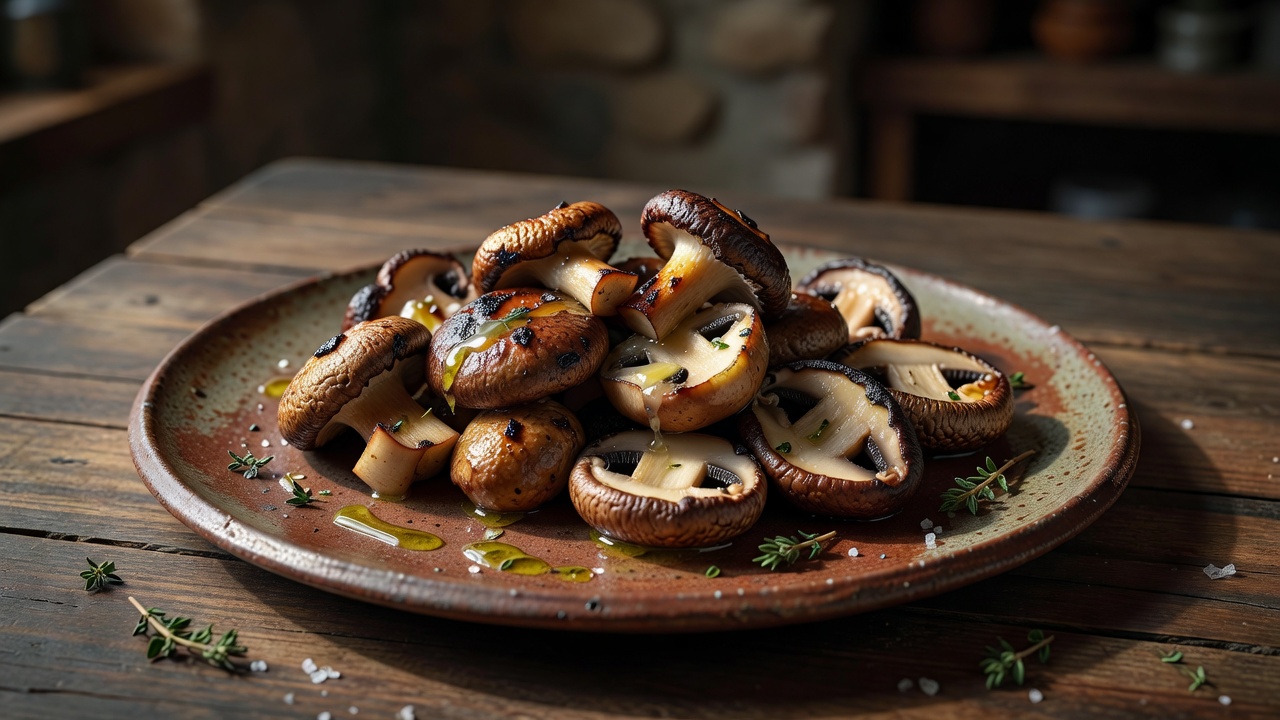
In a restaurant, roasting, grilling and pan cooking can create contrasts that matter more than a decorative garnish. A firm piece may sit against a soft grain preparation, while a thin crisp adds a brief, dry texture. Listen for how the server describes the intended bite. A deliberately yielding mushroom is not necessarily an unsuccessful attempt at crispness; the dish may be built around tenderness.
Extraction changes the scale
A mushroom broth shifts attention away from the whole ingredient toward its soluble flavour. A kitchen might use an infusion, stock or reduction as a base, then adjust the result with acidity or fat. These are related but different operations. Reducing a liquid concentrates salt as well as flavour, and a dark colour does not prove either long cooking or superior depth.
Umami is a useful word here, provided it does not become a substitute for description. Mushrooms can contribute savoury compounds; their effect also depends on the other ingredients present. A spoonful of broth alongside cabbage may feel more precise than a heavy sauce. Equally, a rich sauce can be coherent when the rest of the course supplies freshness and contrast.
Preservation is a transformation
Drying changes both texture and aroma. A dried ingredient rehydrated into stock is not simply a fresh one held in suspension until winter. Freezing, pickling and fermentation each produce different results, and their suitability depends on the ingredient and a controlled process. A restaurant’s preserved pantry is therefore a record of decisions, not an automatic certificate of ecological virtue.
The fermentation work associated with Copenhagen’s Noma helped bring greater public attention to the pantry as a creative space. The Noma Guide to Fermentation, by René Redzepi and David Zilber, is one documented reference within that wider conversation. It should not be read as permission to improvise the treatment of unidentified fungi. Identification, ingredient suitability, hygiene and validated process controls remain separate responsibilities.
A small ingredient glossary
Menu vocabulary can illuminate a preparation, but only if its limits stay clear. These terms describe culinary forms, not instructions for collection or processing.
Dried mushroom powder
A finely ground dried ingredient used to distribute flavour or change a surface texture. Ask which mushroom is involved; the word “powder” says nothing about its identity or suitability.
Mushroom consommé
A clear, flavourful broth, sometimes clarified through an additional kitchen process. Clarity is a presentation characteristic, not a guarantee that the stock is vegetarian or free of allergens.
Koji and mushroom preparations
Koji refers to a cultivated mould used in specific food processes, often on grains or legumes. A mushroom dish described alongside koji may include a separate seasoning; the terms are not interchangeable.
Read the finished course as a whole
Consider the interaction between mushroom and surroundings. Rye might add bitterness and crunch; cultured cream can soften a concentrated broth; an acidic berry preparation may interrupt richness. None of these ingredients makes a dish Nordic on its own. The interpretation emerges through context, sourcing, technique and the restaurant’s stated approach.
The most useful response is often a specific question: what is creating the acidity, which part was preserved, or why was this texture chosen? These questions allow the kitchen’s work to become legible without turning dinner into an examination. For the next part of that conversation, follow the ingredient back toward its supplier and season.
Follow the seasonal supply